

Sena Chang ’28 spent this summer interning at LAist, a Los Angeles-based NPR station operated by Southern California Public Radio, with support from the Program in Journalism and the Princeton Internships in Civic Service (PICS) program, administered by the Pace Center. At LAist, she produced stories across formats, ultimately publishing nine features to the site. Her stories spanned topics ranging from the Altadena community’s recovery after the Eaton Fire, to the arrival of a newborn penguin at a Long Beach aquarium. In addition to the internship, Chang traveled to Minneapolis to attend the Asian American Journalists Association’s annual convention, as a VOICES Fellow.
In this Q&A, Chang discusses the stories she pursued this summer, the skills she cultivated through working across visual and audio mediums, and her commitment to impact-driven journalism.
Describe the work you did this summer.
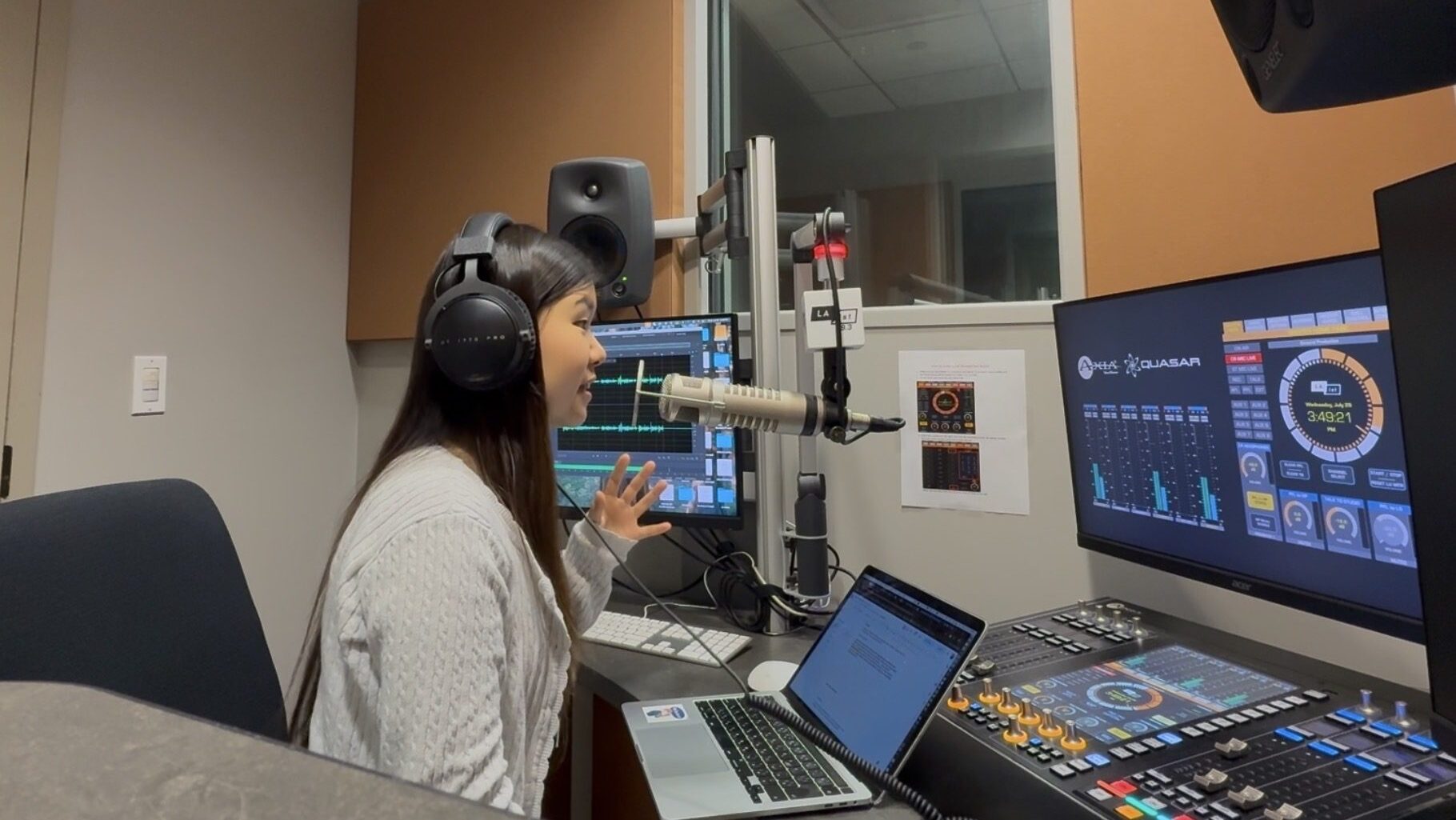
I produced web stories, audio, and social video for Los Angeles’s largest NPR station, LAist (89.3 FM), operated by Southern California Public Radio. My stories took me across the city, from speaking to Eaton Fire survivors to helping cover a controversial water reuse project along the Arroyo Seco to seeing a newly born penguin. I spent my time between the LAist office and out in the field. My radio stories appeared on LAist’s newsmagazines “All Things Considered,” “The LA Report,” and “Morning Edition” multiple times, and my article on the San Andreas fault became the top-read web story of the week on LAist.com.
In the middle of my internship, I also had the pleasure of presenting a story I reported from a tea farm in rural Japan at the Asian American Journalists Association’s annual convention as a VOICES fellow, which took me to Minneapolis.
What were two memorable projects or assignments that you were a part of?
One of the most memorable assignments of my internship began at a town council meeting in Altadena, where more than 450 residents gathered to protest the application of California housing density laws, SB 9 and SB 1123, to their community. Over a year earlier, wildfires had devastated Altadena, destroying thousands of homes and displacing many families. Now, many feared new development could reshape the neighborhood’s character.
This turned into several weeks of reporting. I went to Altadena again, photographing burned lots and charred trees. I reviewed building permits, lawsuits filed by developers, and legislation. I interviewed residents about what it would take to come home, and what these new developments could mean to their community, in addition to housing experts, politicians, and a variety of stakeholders to understand the competing forces shaping the community’s recovery.

This was such a powerful reporting experience as it changed how I thought about rebuilding after a disaster. I confronted questions about how insurance shortfalls and development pressures can determine both what a community looks like after a fire and who gets to remain part of it. How do you rebuild a neighborhood, its people, history, and sense of community after a great calamity?
I also had the opportunity to report from a train station in Anaheim, which is one of the few places in L.A. using a technology called radiant cooling. I loved this assignment as it forced me to think creatively about what audio components could be used for radio, and I learned that such interesting stories can sometimes come from the most mundane of places.
Tell us about something that you learned this summer.
This summer reminded me that journalism is, ultimately, about people and the communities we write for. At times, journalism can feel like you are an outsider looking in, seeking to swiftly document an event or development. But working in a community-funded newsroom with longstanding ties to the people it covers taught me that it is possible to be embedded in a community and care deeply about it, while still reporting on it critically and objectively. To have the privilege of witnessing how the newsroom’s stories were creating a real impact on communities across L.A. reminded me that writing is fundamentally a two-way dialogue between the writer and the reader, and to constantly keep in mind the audiences I am serving and want to serve through my journalism.
This experience made me think differently about the kind of journalism I want to produce. Behind every policy, lawsuit, or statistic are people whose lives are being shaped by what we write about. I want to do more reporting in the future that is useful and impactful to the communities it is meant to serve, much like how LAist’s reporters seemed to approach their work.
How do you think that this internship might contribute to your future goals or career plans, in journalism or beyond?
Throughout the summer, I was constantly confronted with the fact that the landscape of media is one that is changing rapidly. Given this, it was a privilege to be able to engage in different forms of storytelling throughout my internship, from shooting video for social media for the first time to using professional radio equipment and becoming comfortable with writing for radio, as someone more familiar with traditional print journalism. My experience at Southern California Public Radio and LAist was an incredibly meaningful one, and it most definitely reaffirmed my dreams of becoming a journalist. I will forever be grateful to my editor Matt Ballinger, as well as Nubia Perez, David Rodriguez, and Mary Plummer for helping coordinate such an amazing internship program.
Check out some of the pieces published in LAist by Chang:
What will a rebuilt Altadena look like? Residents push a state bill that would limit density
By Sena Chang ’28
The future of air conditioning could already be in use in a SoCal train station
By Sena Chang ’28
For first time in 8 years, baby penguin debuts at Aquarium of the Pacific in Long Beach
By Sena Chang ’28
All of her published stories can be found on the LAist website.