

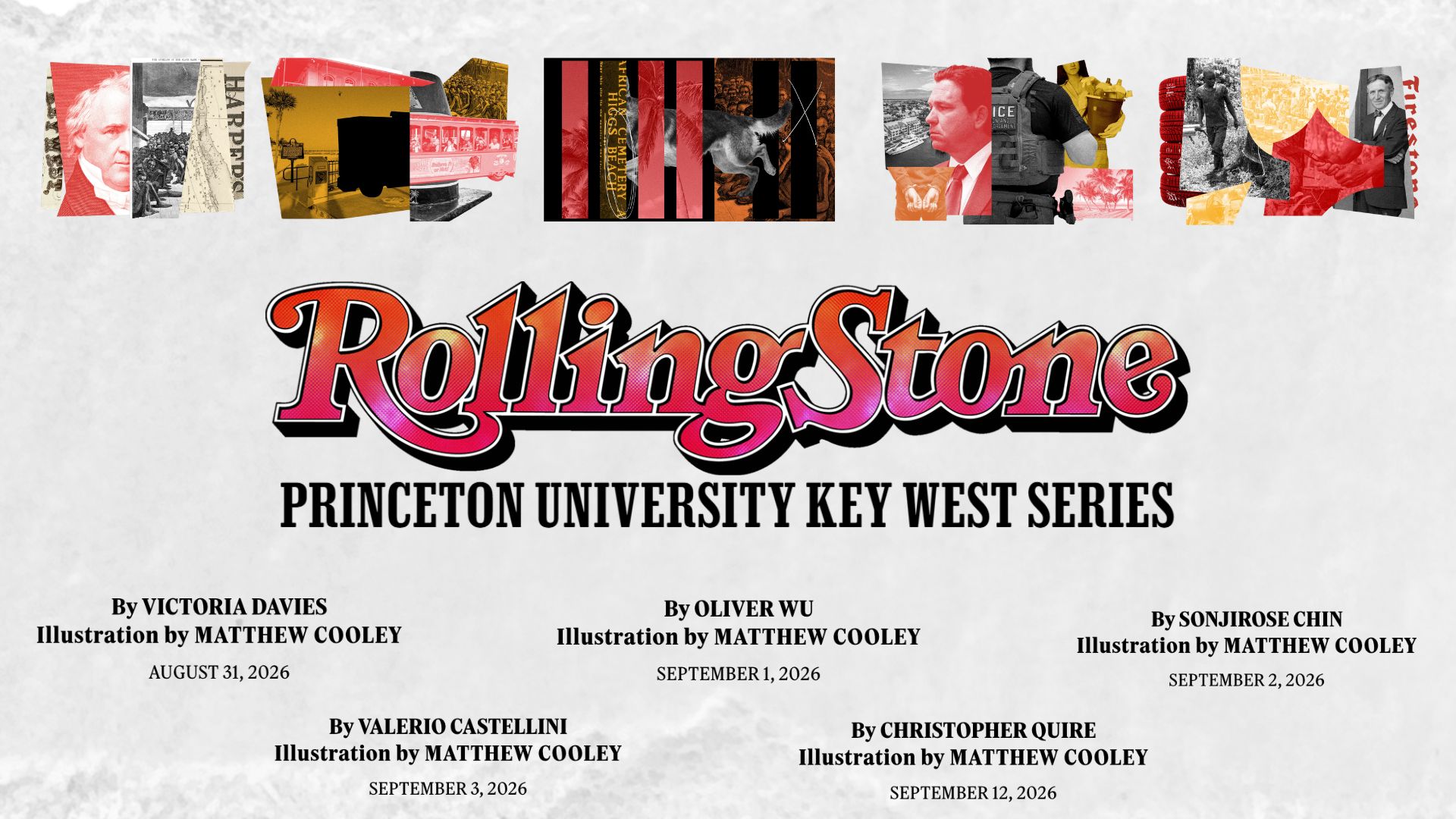
Five Princeton Journalism students – Valerio Castellini ’28, Sonjirose Chin ’28, Victoria Davies ’27, Christopher Quire ’28, and Oliver Wu ’29 – are featured in Rolling Stone, as the authors of a special five-part ‘Key West series’ for the publication. Each student developed, reported, and wrote a unique piece, which was revised and refined in direct collaboration with editors and fact checkers at Rolling Stone before being published by the magazine.
The reporting originated from their work in the Program in Journalism undergraduate course “Diving into the Wreck: Immersive and Investigative Reporting Methods,” taught by David Kushner, a Visiting Ferris Professor in Journalism in Spring 2026.
Over the course of the semester, students learned techniques for immersive and investigative reporting for narrative nonfiction, and developed original features related to an African burial ground in Key West, Florida.
The published stories cover topics ranging from the discovery of unmarked graves at Higgs Beach, to an unlicensed Black-history tour, to federal policing of immigrants in Key West, to Princeton’s own ties to the Firestone rubber plantation in Liberia.
The class traveled to the island in Florida during spring break, where they met with divers, marine archaeologists, historians, and community members. Some interviews were planned in advance, but students also had time to find and meet with their own sources.
In Key West, Sonjirose Chin ’28 met Arida Wright, a small business owner struggling to secure a license for her Black history island tour.
“While in Key West, it was really great being able to visit all the historical sites for myself and get a first-hand experience with Arida and her tour,” said Chin, who is majoring in African American studies and minoring in journalism and creative writing. After working with the “kind and patient” editors at Rolling Stone, Chin said she was “deeply proud of telling this important story for not only Arida but Black history in Key West and beyond.”
Journalism minor Oliver Wu ’29 spent time researching more than 100 unmarked African graves in Key West for his feature story.
“Piecing together the full history of the grave site required quite a bit of sourcing, archival research, and public records requests, as it’s been over 25 years since knowledge of the graves resurfaced, and the relevant figures have changed over time,” said Wu, who plans to major in the Princeton School of Public and International Affairs. “I was drawn to the topic because, beyond the historical importance of the graves, it was also a very timely discussion as Key West works on developing new plans for Higgs Beach.”
Kushner helped students develop ideas for their feature stories and made the initial connection with Rolling Stone when he invited deputy editor Maria Fontoura to visit the class early in the semester. Fontoura continued to work closely with the students, talking through their early story pitches, providing feedback and edits on their drafts, and showing the students around the magazine’s New York City headquarters during a visit in April.
“Working with Rolling Stone was a fantastic experience — the sharp editing taught me a lot about conciseness and structure,” said Wu. “It was also cool to see the fact checking process prior to publication.”
Following several months of reporting, editing, and fact checking in collaboration with the magazine’s team, all five stories are now published on the Rolling Stone website.
Read the stories:
- The Secrets Buried Beneath the Sands of Key West
By Victoria Davies - ‘Since It Is a Black Cemetery and Has the Stigma of Slavery, No One Wants to Touch It’
By Oliver Wu - There are No Guided Black-History Tours in Key West. One Woman is Trying to Change That
By Sonjirose Chin - ‘They’ve Done Everything Right, and They’re Still Being Detained’
By Valerio Castellini - I’m a Princeton Student. The Story of Its Ties to Slavery and Exploitation Must Be Remembered
By Christopher Quire